
The Wrong Sign, The Right Choice
Do you expect your principal amount to grow significantly after interest, or barely move at all?
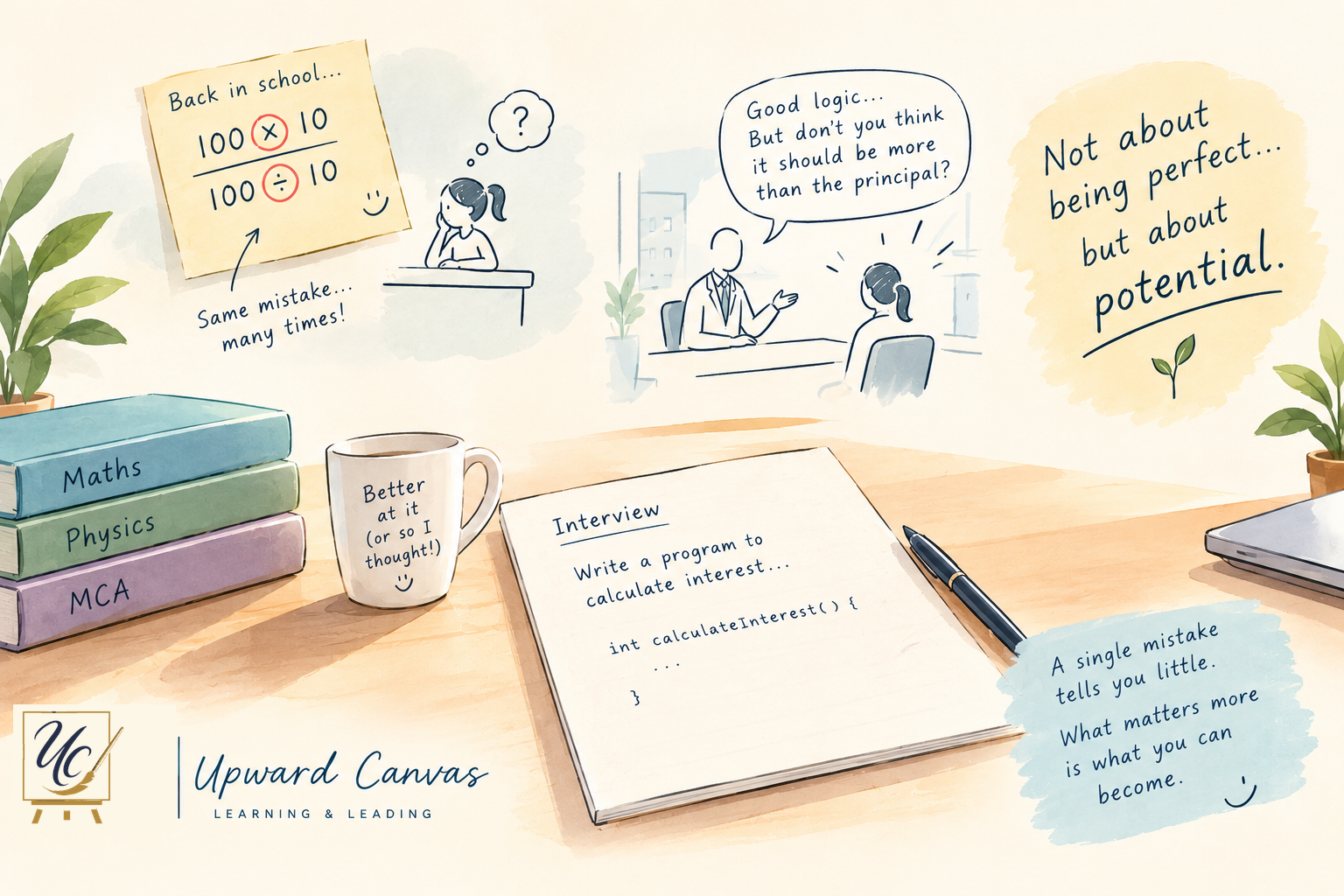
A math mistake. A job interview. A lesson in potential...
For me, the probability of miscalculating exactly how much it should grow was always high, right up till 5th standard. It’s not that I couldn’t understand the question. Somehow, in the rush of an exam, I always ended up doing multiplication instead of division, or the other way around. I never caught it in the exam hall. Only later, back home, looking at the paper again, wondering what had gone wrong.
This was frustrating and funny at the same time. So much so that my family’s first question after every math exam became a running joke: “did you do multiplication instead of division again?”
But over time, I got better – not just at profit & loss, but at pretty much everything. Especially in college, where my notes were circulating in the hostel, and I was the go-to person for group theory questions. I even got scholarships for securing highest marks in my class. I was, at that point, quite sorted – sorted enough that I wanted to major in mathematics for my graduation. I somehow ended up with Physics instead (by choice- influenced, obviously 😉).
By the time I finished my masters (MCA), I was well over my school-time embarrassment.
But life always finds the opportunity to make you humble again. After clearing the written exams for my first company during campus placement, I was called in for an interview with the CEO.
It was a big office. I sat across the table from him. He was kind enough to make sure I didn’t feel intimidated by his seniority, and the conversation went really well. Then, near the end, he asked me to write a program to calculate interest using standard and recursive logic.
Writing code on paper is trickier than it sounds. You can’t compile it, can’t catch your own errors the way you would on a computer. I was mostly worried about syntax, that’s where I expected to slip. I finished, handed the paper back, and he took his time reviewing it while I sat there wondering what he was thinking.
Then he looked up and said:
“Your logic, your syntax – everything is perfect. But Sangeeta, don’t you think if I invested this amount, the return should be much higher than what you’ve shown here?”
And he smiled. He wasn’t ignoring the mistake – he’d clearly caught it immediately. He just didn’t treat it as disqualifying. The question, it seemed, was less about getting the numbers exactly right, and more about whether I understood the difference between the two approaches standard and recursive.
I knew exactly what had happened – the same habit from school, swapping multiplication and division. And at that moment I told him about my own school-time joke – how many times I’d made that same mistake back in school.
The good news: I still cleared that interview 😊, did my internship in the same company, and later got a permanent role of “Quality Assurance Engineer”
What stayed with me
I’ve learned that later in life, you can laugh at your own mistakes – and it’s not strange to share them, no matter the room or the audience. Everyone makes mistakes anyway.
We spend a lot of time looking for the flaw. It’s easier that way – a flaw is easy to spot, easy to point to.
I never asked him directly, but I’ve always assumed he wasn’t looking for a flaw. He’d already found one. It just didn’t seem to matter to him. What he seemed to be asking was something simpler:
does this person have what it takes to grow into the role? Not – are they already perfect at it?
That’s something I’ve carried into every interview since sitting on the other side of the table.
I’ve stopped asking, “what’s wrong with this answer?”
Instead of stressing over a few mistakes, I now focus on potential.
Every person starts from a different place.
We can’t expect everyone to be at the same level on day one.
What matters more is their fit and what they’re capable of becoming in future.
This isn’t always easy to judge, and I don’t always get it right. But I’ve learned that a single mistake tells you very little on its own. Potential shows up elsewhere – in how someone thinks, how they respond, what else they bring to the table.
A mistake is real. It stays real. It just doesn’t have to be the whole story – not if someone’s willing to look past it.
Written by: Sangeeta Singh · ItiAsmi | About →